China Beijing Opera
 |
 Beijing Opera Pictures Beijing Opera Pictures |
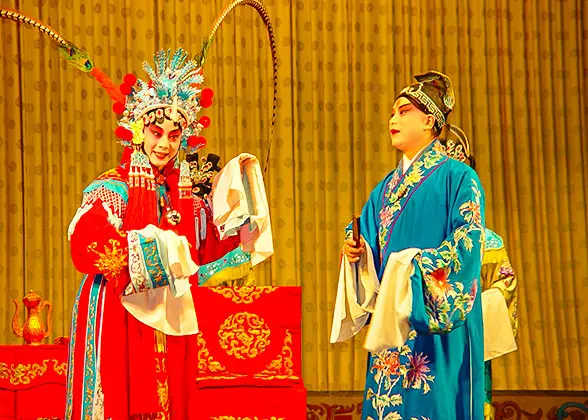
Beijing Opera is developed from absorbing many other dramatic forms, mostly from the local drama 'Huiban' which was popular in South China during the 18th century. It is a scenic art integrating music, performance, literature, aria, and face-painting. Certain rules are set up and regulations are standardized during many artists' long practice on stage. Different from regional plays, it is stricter on the variety of the workmanship. The combination of virtual and reality - a special technique of expression, keeps it largely free from the restriction of time and space on stage performance. Beijing Opera has had many interesting names since it came into being, such as Jinghuang, Daxi, Pingju, Jingxi.
Four Means of Artistic Presentation
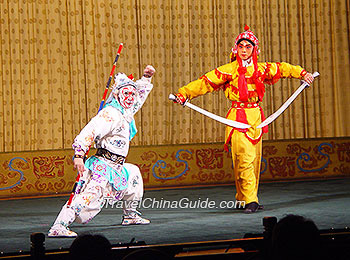 Beijing Opera presents dramatic plays and figures mainly by infusing four artistic methods: singing, dialogue, dancing and martial art. Singing is utilized to intensify the appeal of the art by all kinds of tones. Dialogue is the complement of singing which is full of musical and rhythm sensation. Dancing refers to the body movements requiring high performing skills. Martial art is the combination and transformation of traditional Chinese combat exercises with dances.
Main Roles in Beijing Opera Performance
Sheng:
Dan:
Jing:
Facial Painting (Lianpu)
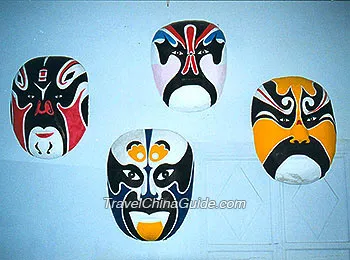 |
| Facial painting in Beijing Opera |
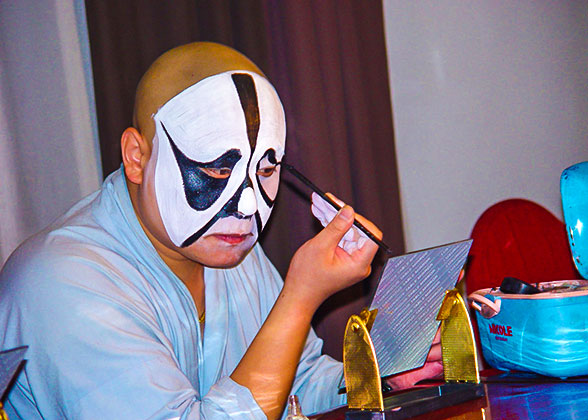
Colors of Lianpu are varied with each representing a characteristic. For example, red symbolizes loyalty, such as Guanyu, a great general during Three Kingdoms Period (220-280). Black signifies honesty and frankness, such as Lord Bao, a righteous official during Northern Song Dynasty (960-1127), or abruptness and impertinence, such as Likui, an important figure in the famous Chinese ancient novel 'All Men Are Brothers'. White stands for cattiness and cunning, with Caocao as its representative, a famous politician in the late Eastern Han Dynasty (25-220).
Stage Properties (Qimo)
Four Famous Artists
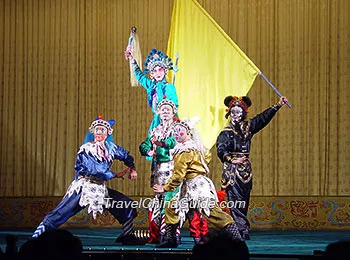 There are many famous masters who are good at performing Beijing Opera. Among them, the Four Famous Dans - Mei Lanfang, Cheng Yanqiu, Shang Xiaoyun and Xun Huisheng - are most well-known at home and abroad. They are experts in performing the role of Dan and each has his own artistic feature. Their wonderful performances are still appreciated by many audiences. For example, 'Farewell My Concubine' by Mei Lanfang, 'Injustice to Dou'e' by Cheng Yanqiu, 'Lady Zhaojun Going beyond the Great Wall' by Shang Xiaoyun and 'Matchmaker' by Xun Huisheng.
Beijing Opera contains the soul of Chinese national culture. Its unique charm inspires ethos of Chinese people. There is no doubt that it is really the treasure of Chinese culture. If you want to taste the real Beijing Opera, Liyuan Theatre in Beijing will be a good choice for you. Related Reading: Beijing Opera Theaters, Beijing Travel Guide
- Last updated on Sep. 25, 2024 by Brenda Lian -